Nice Isn't the Same as Yes: Helping Your Kid Learn That Saying No Is an Act of Courage, Not Cruelty
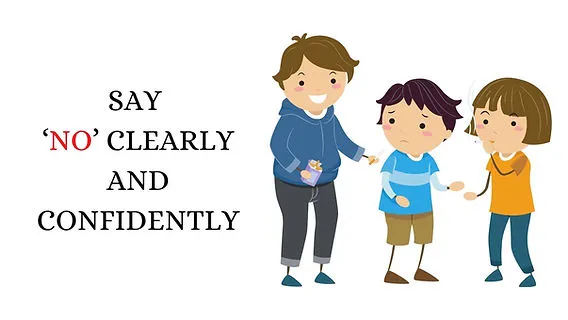
Photo: child confidently saying no to peer pressure empowerment, via static.wixstatic.com
Somewhere around age seven, a lot of kids figure out a quiet but consequential equation: being liked means saying yes. To the friend who wants to copy homework. To the cousin who keeps taking their stuff. To the adult who asks for a hug they don't want to give. They learn — through a thousand small moments — that their comfort matters less than keeping the peace, and that the word "no" comes with a social price tag.
For some kids, this lesson takes root especially deep. Kids who are naturally empathetic. Kids who've been praised for being "so easy" or "so helpful." Kids who've learned, in one way or another, that their value to the people around them is tied to how accommodating they can be.
The result, over time, is a child who doesn't know where their own needs end and everyone else's begin. And that's not kindness. That's a setup.
The People-Pleasing Pipeline
People-pleasing in children doesn't come from nowhere. Often it's the product of genuinely good instincts — empathy, a desire for connection, a sensitivity to others' feelings — that have been shaped, without anyone intending harm, into something less healthy.
Research in developmental psychology has consistently shown that children — particularly girls, though certainly not exclusively — are socialized to prioritize relational harmony over personal assertion. Girls are more frequently praised for being cooperative, nurturing, and agreeable. Boys who exhibit the same tendencies are sometimes encouraged to "toughen up," which creates its own set of problems but results in a different relationship with the word "no."
Dr. Rachel Simmons, author of Odd Girl Out and a longtime advocate for girls' emotional health, has written extensively about how the pressure to be "nice" teaches girls to suppress conflict rather than navigate it — and how that suppression has real psychological costs. Anxiety, resentment, and a chronic sense of being unseen are common outcomes for kids who've never been given permission to advocate for themselves.
But this isn't only a girls' issue. Kids with anxious temperaments, kids who've experienced instability at home, and kids who are natural peacemakers are all vulnerable to the same pattern — regardless of gender.
What "No" Actually Teaches
Here's the reframe that changes everything: saying no isn't the opposite of kindness. In many cases, it's an expression of it — toward yourself, and sometimes toward others too.
When a child says no to copying homework, they're protecting their friend from a habit that will eventually backfire. When they decline a hug from a relative they're not comfortable with, they're practicing the exact same bodily autonomy that we hope will protect them in much higher-stakes situations later. When they tell a friend "I can't hang out today, I need some quiet time," they're modeling honest communication that actually makes relationships healthier.
But kids can't access any of that logic if they've been taught — explicitly or implicitly — that their job is to manage other people's feelings at the expense of their own.
Dr. Brené Brown, whose research on vulnerability and shame has influenced parenting conversations for the better part of two decades, puts it plainly: we can't practice genuine compassion toward others if we've completely abandoned compassion toward ourselves. Teaching kids to say no isn't teaching them to be selfish. It's teaching them that they count too.
The Guilt Trap
One of the biggest obstacles kids face when they try to set limits is guilt. Even when they know, intellectually, that they have the right to say no, the emotional experience of doing it can feel awful. Their stomach drops. They imagine the other person being hurt or angry. They replay the interaction for hours afterward, wondering if they were too harsh.
This guilt is worth taking seriously — not because it means the child did something wrong, but because it's usually a sign that the internal narrative needs updating. If a child genuinely believes that their needs are less important than everyone else's, then asserting those needs will always feel like a transgression. The work isn't to eliminate the discomfort entirely — it's to help kids develop a more accurate story about what they deserve.
Practical language matters here. There's a big difference between "no" delivered as rejection and "no" delivered with warmth and clarity. Teaching kids phrases like "I can't do that, but here's what I can do" or "That doesn't feel right for me" or even simply "I need to think about that before I answer" gives them tools that feel less like slamming a door and more like opening a window.
Real Scenarios, Real Scripts
Abstract conversations about boundaries rarely stick. What works better is walking kids through specific situations and practicing actual language together.
When a friend pressures them to leave out another kid: "I don't want to do that. Let's find something all three of us can do."
When an adult asks for physical affection they're not comfortable with: "I'm not really a hugger right now, but I'd love to wave!" (And critically — back your child up if the adult pushes back. This is non-negotiable.)
When a classmate asks to copy their work: "I worked really hard on mine, and I don't want to share answers. But I can help you study if you want."
When they're overcommitted and need to cancel plans: "I said yes before, but I'm realizing I need some time for myself. I'm sorry for the short notice — can we reschedule?"
Role-playing these scenarios at home — without stakes, without judgment, with some humor if possible — builds the kind of muscle memory that makes the real moments easier to navigate.
What Parents Need to Examine Too
This is the part of the conversation that's a little uncomfortable but genuinely important: sometimes, without meaning to, we reinforce the very pattern we're trying to help our kids break.
When we insist that our child hug Grandma even after they've said they don't want to, we're teaching them that other people's feelings override their body autonomy. When we praise a child for "being so flexible" every time they give up what they wanted, we're associating self-erasure with approval. When we express disappointment or frustration the one time they push back on something, we're confirming their fear that asserting themselves costs them love.
None of this is intentional. But it's worth noticing.
The most powerful thing a parent can do is model what healthy limits look like — saying no without excessive apology, honoring their own needs without guilt, and treating their child's "no" with the same respect they'd want for their own.
Raising Kids Who Know Their Worth
At Sun Child, we talk a lot about nurturing children's brightest futures — and we mean that in the fullest sense. A bright future isn't just about grades or achievements. It's about building kids who know that they matter, that their comfort counts, and that protecting themselves isn't something to be ashamed of.
Kindness is a beautiful thing. We want kids to have it in abundance. But kindness that comes at the cost of a child's own wellbeing isn't really kindness at all — it's a habit of disappearing. And our kids deserve so much more than that.